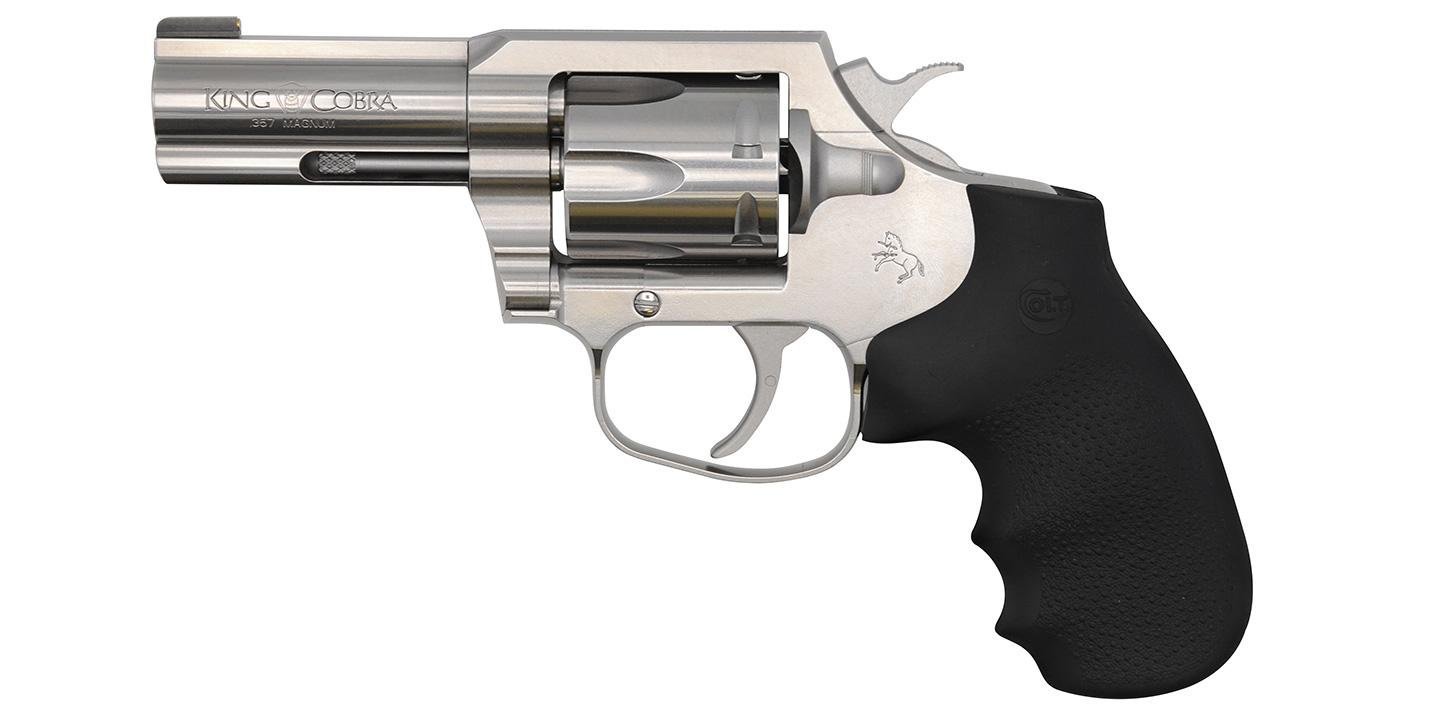
Colt King Cobra

$300.00
| Feature | Historical information |
|---|---|
| Manufacturer | Colt’s Manufacturing Company |
| Model | Colt King Cobra |
| Original introduction | 1986 |
| Reintroduction | 2019 |
| Firearm type | Double-action revolver |
| Construction | Stainless steel |
| Product family | Colt Cobra revolver family |
| Country of manufacture | United States |
The Colt King Cobra is a notable revolver in the history of American firearms manufacturing. Introduced in 1986, it became part of Colt’s well-known Cobra family of double-action revolvers. The model is recognized for its stainless-steel construction, traditional revolver styling, and connection to Colt’s long manufacturing heritage.
Over the years, the King Cobra has appeared in several production periods and configurations. Its history reflects changes in firearm manufacturing, consumer preferences, and Colt’s approach to updating established revolver designs.
1. History of the Colt King Cobra
Colt introduced the original King Cobra in 1986. It was developed as a larger-framed member of the company’s Cobra revolver family and became part of Colt’s expanding double-action revolver lineup.
The original production period continued through the 1990s, with different versions appearing over time. Colt later discontinued the model as the company’s revolver production changed.
In 2019, Colt reintroduced the King Cobra name with a modernized version. This return connected the newer model to the original design while reflecting changes in contemporary manufacturing.
2. Manufacturer Background
The King Cobra was developed by Colt’s Manufacturing Company, an established American firearms manufacturer.
Colt has a significant place in the history of revolver development. Its manufacturing history includes several recognized models that influenced American firearm design during the nineteenth and twentieth centuries.
The King Cobra contributed to this heritage by extending the company’s traditional double-action revolver lineup.
3. Design and Engineering Background
The Colt King Cobra is associated with traditional double-action revolver construction and a stainless-steel exterior.
Its design reflects the styling commonly found in Colt revolvers of its production era. The model’s appearance and construction distinguish it within the company’s historical Cobra family.
The reintroduced version retained the King Cobra identity while incorporating updated manufacturing features. Differences between original and later versions are important when studying the model’s development.
4. Historical Product Information
| Feature | Historical information |
|---|---|
| Manufacturer | Colt’s Manufacturing Company |
| Model | Colt King Cobra |
| Original introduction | 1986 |
| Reintroduction | 2019 |
| Firearm type | Double-action revolver |
| Construction | Stainless steel |
| Product family | Colt Cobra revolver family |
| Country of manufacture | United States |
Specifications and available configurations vary by production year and version.
5. Manufacturing Heritage
The King Cobra represents Colt’s continued development of traditional revolver designs during the late twentieth century.
Its original production period is associated with an era when stainless-steel revolvers became an important part of the American firearms market. The material became recognizable for its appearance and its role in the construction of many revolver models.
The 2019 reintroduction demonstrated the continuing historical relevance of the King Cobra name and Colt’s interest in revisiting established designs.
6. Historical Significance
The Colt King Cobra occupies an interesting position in American revolver history. Its original introduction in 1986 placed it among Colt’s late-twentieth-century revolver designs.
Its return in 2019 also made it an example of a historic firearm model being adapted for a later manufacturing period.
Collectors and firearms historians may study the differences between original production examples and the reintroduced versions to understand how Colt’s design and manufacturing practices evolved.
7. Conclusion
The Colt King Cobra is an important part of Colt’s revolver history. From its original introduction in 1986 to its reintroduction in 2019, the model has maintained a connection to the company’s traditional revolver designs. Its manufacturing background, stainless-steel construction, and place in the Cobra family make it a recognizable subject in American firearms history.
Related products

Pistols
Revolvers
Pistols

Pistols


Revolvers
Revolvers
Revolvers

Pistols